Every great garment starts with a measurement — but the great tailoring relationship starts with a record. Knowing a client's measurements is the minimum; knowing their preferences, their lifestyle, their recurring alterations, their dream garments, and their budget rhythm is what transforms a transactional service into an irreplaceable one. Effective client record management is how you get there.
Why Client Records Are a Business Asset, Not Admin Overhead
Many tailors treat record-keeping as a necessary evil — something to do because clients expect it, not because it creates value. This framing is costing them money. A well-maintained client record is a business asset. It enables faster future appointments (no time wasted re-measuring), personalised communication (reach out when you know a client has an anniversary coming), and accurate pattern recreation (replicate a successful fit perfectly, every time).
Think of your client database as a long-term investment. Each piece of information you add today compounds in value with every future interaction. The more complete your records, the more personalised your service — and personalisation is the single most powerful driver of client loyalty in any professional service.
What to Capture at the First Client Appointment
The first appointment is your opportunity to build a comprehensive record that will serve you for years. Resist the urge to rush — taking 10 additional minutes at the first session to capture thorough notes will save hours across future visits and prevent costly misunderstandings.
- Full measurement set: chest, waist, hips, inseam, shoulder width, sleeve length, neck, back length, and any asymmetries
- Body notes: posture considerations (forward shoulders, swayback), high hip side, arm length variations
- Lifestyle context: profession, typical dress code, how active they are in garments (sitting all day vs. physical work)
- Style preferences: formality, silhouettes they love and avoid, colour palette, fabric preferences
- Reference points: brands or garments they already love the fit of
- Budget range: not just for this project, but their typical investment level in clothing
- Upcoming occasions: weddings, travel, events in the next 12 months that may generate future orders
- Communication preference: WhatsApp, email, in-person, how quickly they expect responses
The Measurement Standard: Precision and Consistency
Measurements are only as useful as they are accurate and consistently taken. Establish a standard measurement protocol and follow it exactly for every client, every time. Always take measurements in the same order, with the client in the same stance, in comparable undergarments. Small inconsistencies in measurement method lead to big inconsistencies in fit.
Retake measurements at every appointment where you're cutting a new garment, not just the first visit. Bodies change — weight, posture, and proportion shift over months and years. Relying on a measurement set from 18 months ago is a common source of fit problems.
Order History: Building a Map of the Relationship
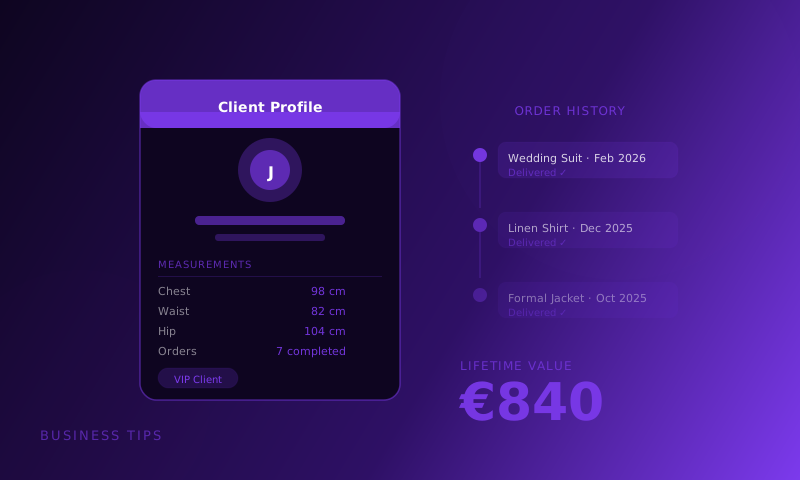
Beyond measurements, your order history is a map of your relationship with each client. Record every commission in detail: the garment, the fabric sourced, the design brief, the delivery date, the final price, any alterations made during fittings, and the client's reaction on delivery. This history has multiple uses: pattern recreation, dispute resolution if a client misremembers a brief, and identifying upsell opportunities.
On Tailorte, order history is linked directly to each client profile, making it easy to pull up the full context of a client relationship in seconds. Before a fitting, review their recent orders: are there patterns in what they're ordering? Are there recurring fit issues you should address proactively? Are there styles they've mentioned wanting but never commissioned?
Preferences and Notes: The Details That Create Loyalty
The most memorable tailoring experiences are built on small details that make clients feel deeply known. Record everything that seems relevant in your client notes: that they're allergic to wool, that they prefer working pockets over decorative ones, that they have a wedding in September they've mentioned twice, that they love wide-leg trousers. These aren't trivial — they're the raw material of exceptional service.
I've had clients say they'll never go anywhere else, not just because the fit is perfect, but because I remembered that they hated buttons and preferred zips. That's not talent — that's notes.
— Tailorte Editorial Team
Using Tailorte's Client Management System Effectively
Tailorte's built-in client management tools are designed specifically for fashion professionals. Each client profile stores measurements, order history, appointment records, and free-form notes in one accessible place. You can update records during or immediately after appointments, ensuring nothing is lost to memory. The system is accessible on mobile, so you can reference client details during a fitting without scrambling for paper files.
Turning Client Records into Business Intelligence
Aggregate your client data periodically to identify patterns that can inform your business strategy. Which clients haven't booked in six months? Reach out with a personal message. Which fabric types are consistently ordered together? Make sure they're always in stock. Which months see the highest order volumes? Hire additional help in advance of those periods. Your client records, reviewed collectively, are a business intelligence dashboard.
- Monthly: Review which clients are overdue for a visit and send a personalised check-in
- Quarterly: Analyse which services and garment types are most in demand and adjust your focus accordingly
- Biannually: Identify your top 20% of clients by order value and consider how to deepen those relationships
- Annually: Review your full client list for churn patterns and develop a re-engagement campaign
Manage your clients, measurements, and orders all in one place. Join Tailorte and build the kind of organised, professional client relationships that drive lasting loyalty.
Set Up Your Client System